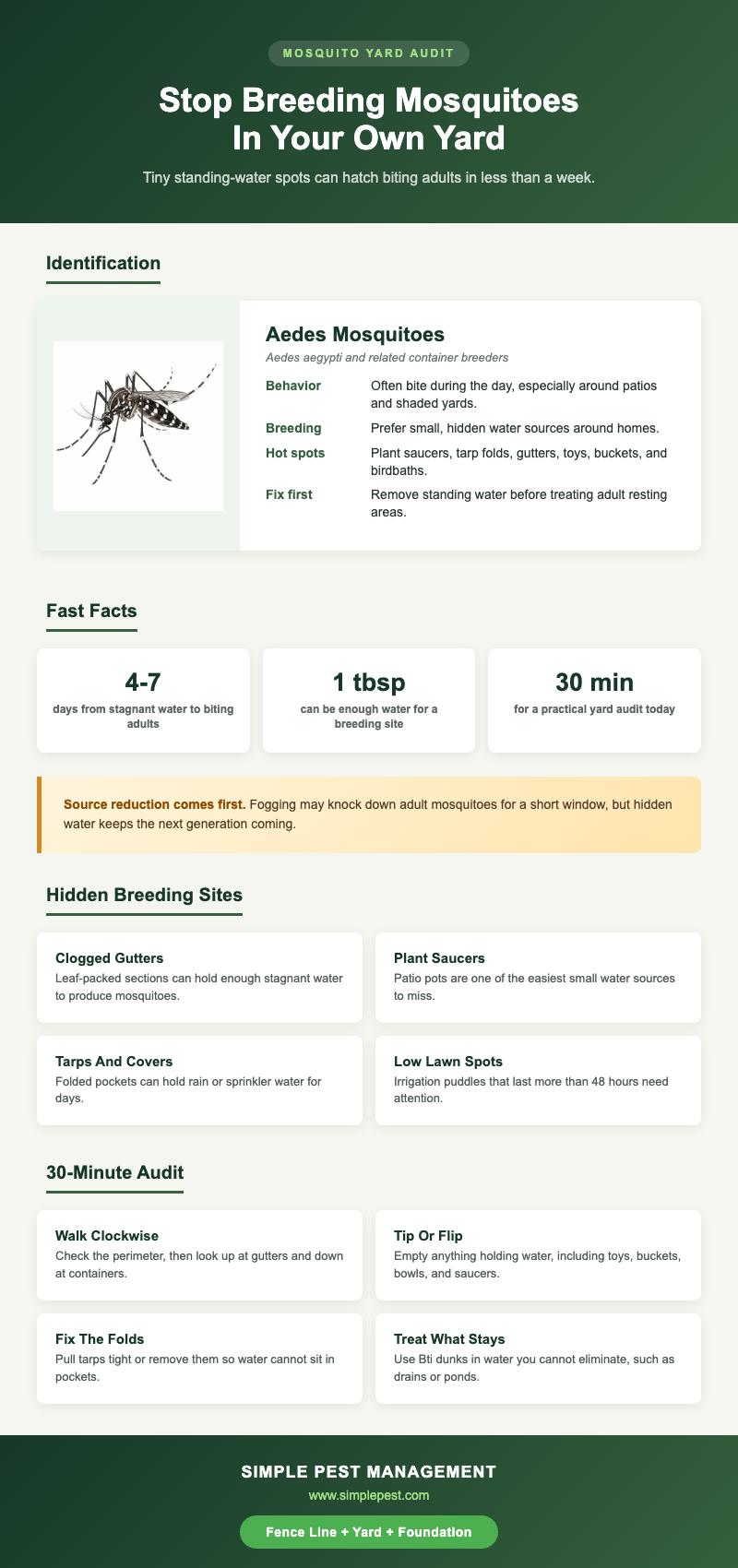


A bottle cap. The folds of a tarp covering your patio furniture. A clogged section of gutter you haven’t cleaned since last fall. Each one holds barely a tablespoon of water. Each one is enough for a female mosquito to lay a full batch of eggs that will hatch into biting adults within a week.
Most Californians blame the neighbors, the canyon, or the creek down the street when mosquitoes take over the yard. The honest answer is usually closer to home. Mosquitoes don’t need a pond. They need standing water the size of a quarter, and your property almost certainly has more of those spots than you think.
At Simple Pest Management, we’ve walked thousands of San Diego and Sacramento yards and found the same hidden breeding sites again and again. This article shows you exactly where to look, what to fix, and where the TriZone™ Defense System fits in if you want to stop the cycle for good.
Why Mosquitoes Move So Fast
A female mosquito only needs four to seven days to turn a teaspoon of stagnant water into a swarm of biting adults. She lays eggs on the water surface or just above the waterline, and the larvae do the rest. That’s why fogging the yard on Saturday morning feels useless by Tuesday — you killed the adults, but the next generation was already in the gutter.
The only mosquito control that actually works long-term targets water first, adults second. If you don’t take the breeding sites away, you’re just renting relief by the hour.
San Diego vs. Sacramento: Two Different Mosquito Problems
Mosquito pressure isn’t the same across SPM’s service area, and the breeding sites differ too.
In Sacramento, the Delta and the lower American and Sacramento River corridors create consistently heavy West Nile Virus pressure — the Sacramento–Yolo Mosquito and Vector Control District tracks it every season. The dominant nuisance and vector species, Culex tarsalis and Culex pipiens, lean on irrigated landscapes, neglected pools, and yard drainage that doesn’t move. If you live in Elk Grove, Natomas, or anywhere near a slough, your problem is sheer volume.
In San Diego, the picture is different. The invasive Aedes aegypti has been established countywide for years now, and it’s a container breeder — it loves the small, hidden water sources around homes. Canyon-adjacent properties from Mission Hills to Scripps Ranch get hit hardest because cool, shaded microclimates extend the breeding season well past what people expect. Aedes aegypti also bites during the day, which is why San Diegans complain about mosquitoes at noon while Sacramento residents mostly notice them at dusk.
The Hidden Breeding Sites Almost Every Yard Has
Walk your property with this list. You will find at least three of these.
- Clogged gutters and downspouts. The single most overlooked breeding site in California. A 10-foot section of leaf-packed gutter can produce more mosquitoes than a backyard pond.
- Plant saucers under potted plants. Patio pots are the #1 Aedes breeding site we find in San Diego. Empty saucers twice a week or switch to self-draining ones.
- Tarp folds and pool covers. Pockets of rainwater sit in tarps for weeks. If you can’t pull it taut, pull it off.
- Bromeliads and other water-holding plants. They’re beautiful and they’re mosquito nurseries. Flush them with the hose every few days during warm months.
- Corrugated drain pipes (the black flexible ones). Water pools at every low point inside the corrugation. Replace with smooth PVC if you can.
- Wheelbarrows, kid toys, dog bowls, buckets. If it can hold a tablespoon, it can hatch a brood. Flip everything over.
- Birdbaths and fountains. Refresh every 2–3 days, or run a small recirculating pump — mosquitoes won’t lay in moving water.
- Neglected pools and spas. A green pool is a regional public health problem, not just yours — your local mosquito and vector control district can usually help if you report one.
- Irrigation overspray and low spots in the lawn. If puddles last more than 48 hours after watering, fix the grade or the schedule.
What Works — and What Doesn’t
Before you spend money on a yard gadget, here’s the honest scorecard.
- Bug zappers: don’t work for mosquitoes. The vast majority of what they kill are harmless moths and beetles, not biting insects.
- Citronella candles: minimal effect. Some reduction in bites within a foot or two, and only when the air is still.
- Ultrasonic repellers: don’t work. There’s no credible evidence that sound repels mosquitoes.
- Foggers and yard sprays: short-lived. Fine before a party, useless as a strategy.
- Bti dunks (Mosquito Dunks): genuinely effective. Drop them in any standing water you can’t eliminate — rain barrels, ornamental ponds, drain catch basins — and they’re harmless to pets, fish, and people.
- Source reduction — actually getting rid of standing water: still the single most effective mosquito control approach available.
- Targeted yard treatment focused on adult harborage: works when paired with source reduction, not as a standalone.
Where TriZone Fits In
Mosquitoes don’t care about your property line, but they do follow predictable harborage patterns. The TriZone system treats the fence line, the yard, and the foundation as three separate intervention points instead of one giant fog target.
The fence line work knocks down adults coming in from the neighbor’s untreated yard, the canyon, or the greenbelt. Yard treatment focuses on the shaded, humid harborage zones where adults rest during the day — dense shrubs, the underside of decks, ivy beds. Foundation work catches the moisture-loving species that hug the house. It’s a slower, more methodical approach than fogging, and it’s why our customers don’t end up calling us back two weeks later.
A 30-Minute Mosquito Audit You Can Do Today
You don’t need a checklist app or a pest control degree. Set a 30-minute timer and do this:
- Walk the perimeter of your house clockwise. Look up at the gutters, look down at every container.
- Tip out, flip over, or refresh every container that holds water.
- Check each potted plant. Empty the saucer.
- Pull the tarp off the woodpile or the BBQ. Let it dry. Refold without pockets.
- Run irrigation for one cycle and watch where water sits 48 hours later. Those are your problem zones.
- Drop a Bti dunk in anything you can’t empty.
Done honestly, this single walkthrough will significantly cut your mosquito pressure before anyone touches your yard with a sprayer.
When the Audit Isn’t Enough
Some situations need outside help: daytime biting that suggests Aedes aegypti, a property backing up to a canyon, slough, or open creek, or a neighbor whose green pool you can’t get drained. In those cases source reduction alone won’t close the gap, and you need trained eyes on the harborage zones plus a treatment plan that doesn’t flatten the beneficial insects you actually want around.
That’s the situation where the TriZone™ Defense System does its best work — layering treatment across the fence line, yard, and foundation instead of fogging the yard once and hoping. If your own audit gets you to a livable yard, that’s a win. If it doesn’t, Simple Pest Management is around in San Diego and Sacramento.