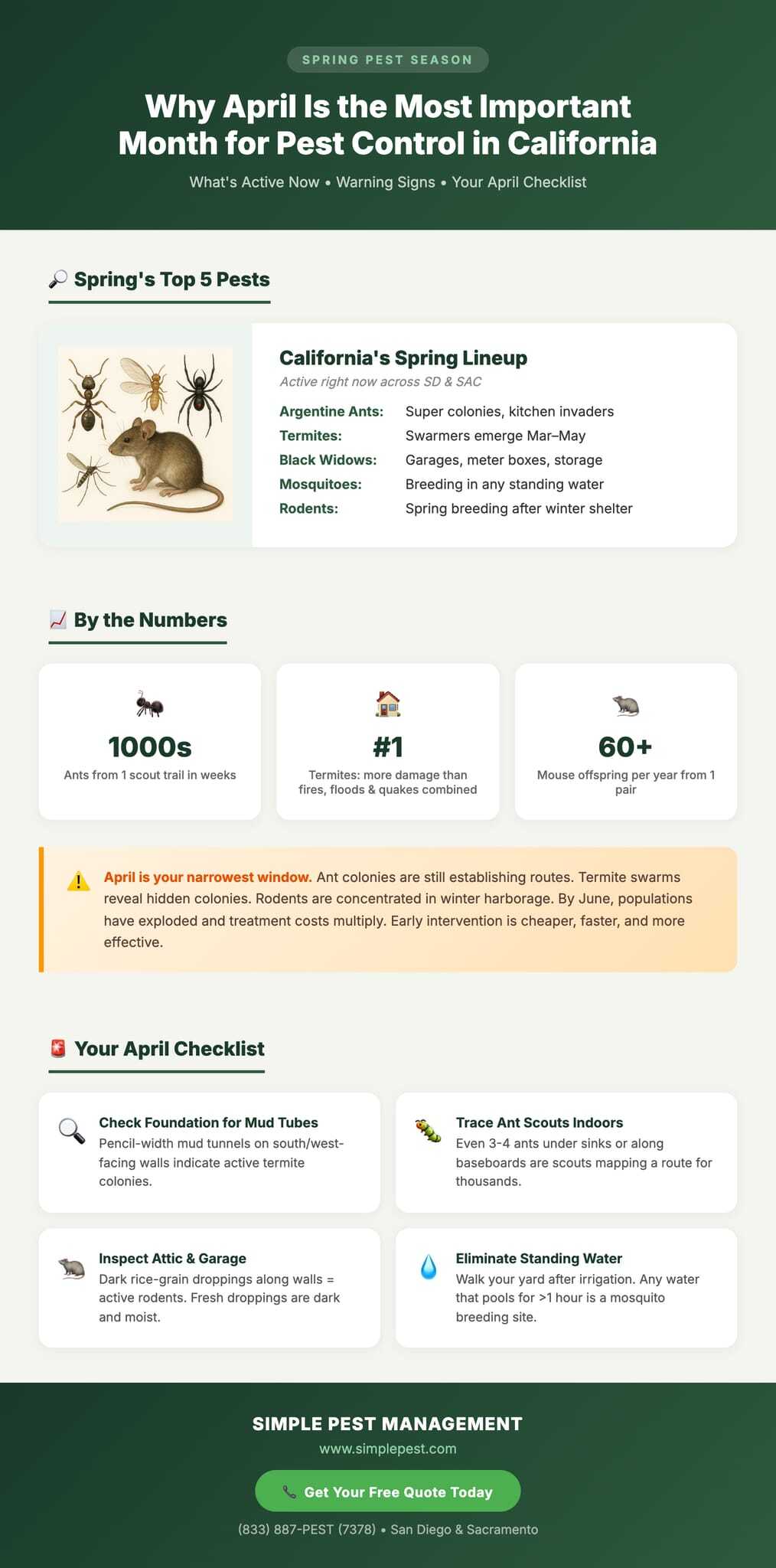


Right now, in your yard, things are waking up. Argentine ants are sending scouts along your foundation. Subterranean termites are preparing to swarm. The rodent pair that overwintered in your attic just had their first spring litter. April is the narrow window where all of these problems are still small enough to stop — and the month most California homeowners do nothing.
By May, that scout trail is a superhighway of thousands. By June, those termite swarmers have already mated and started a new colony in your wall void. Spring pest control isn’t about reacting to what you see. It’s about intercepting what’s building before it reaches the point where treatment gets expensive and disruptive.
At Simple Pest Management, we built our entire approach around this principle. Our 3-zone barrier system — treating your fence line, yard, and foundation — is designed to intercept pests during exactly this kind of early-season activity, before they ever reach your living space.
What’s Active Right Now In California
Spring pest pressure varies across the state and knowing what’s dominant in your area helps you prioritize.
Ants are the most common spring complaint we handle across every service area. In San Diego, Argentine ants dominate — massive super colonies that send foraging trails along moisture lines and into kitchens the moment irrigation season starts. In Sacramento, odorous house ants are more prevalent, nesting under slabs and in wall voids near water heaters and bathrooms. Both species can establish thousands-strong colonies from a single queen in weeks.
Termites swarm in California between March and May, typically triggered when soil temperatures reach the mid-70s after a rain event. If you see winged insects emerging from your foundation, baseboards, or a woodpile, that’s not the start of a problem — it’s evidence of a mature colony that’s been feeding for months or years. Subterranean termites cause more structural damage in California than fires, floods, and earthquakes combined.
Spiders become more visible in spring as prey populations increase. While most California spiders are harmless, black widows and brown widows are common in garages, meter boxes, and outdoor storage areas across both San Diego and Sacramento. Spring de-webbing and perimeter treatment significantly reduces spider activity heading into summer.
Mosquitoes ramp up quickly once temperatures stay above 50°F overnight. Any standing water — a forgotten plant saucer, a clogged gutter, even a bottle cap — is a potential breeding site. Sacramento-area homeowners deal with more mosquito pressure due to the river systems and agricultural irrigation, but San Diego properties near canyons and with poor drainage aren’t far behind.
Rodents that sheltered in attics, garages, and crawl spaces during winter start breeding aggressively in spring. A single pair of mice can produce 60+ offspring in a year, and rats aren’t far behind. Spring is when you’ll notice droppings, gnaw marks, or hear scratching in walls — all signs that a winter guest has settled in permanently.
Why Timing Matters More Than You Think
Pest control in April is fundamentally different from pest control in July. Here’s why.
In April, ant colonies are still establishing foraging routes. Treatments applied now disrupt colony communication and food supply before populations hit critical mass. By midsummer, you’re fighting entrenched colonies with multiple satellite nests — a much harder problem.
Termite swarm season is a diagnostic event. It tells you where colonies already exist. If you schedule an inspection in April and find evidence of activity, you can treat before structural damage accelerates through the warmer months when termites are most active.
Rodent exclusion is easier in spring because you can identify entry points while populations are still concentrated in their winter harborage areas. Once they start breeding and dispersing, sealing one entry point just pushes them to another.
The math is straightforward: early intervention costs less, works faster, and prevents the kind of widespread infestation that requires multiple treatment visits.
What Actually Works vs. What Doesn’t
Not all spring pest prevention is created equal. Here’s what moves the needle and what’s mostly noise.
High impact: Professional perimeter treatment in early spring. This creates a chemical and physical barrier that intercepts pests at the most common entry zones — foundation edges, weep holes, utility penetrations, and door thresholds. SPM’s Tri-Zone system extends this barrier outward to your fence line and yard, which means pests encounter treatment long before they reach your home.
High impact: Moisture elimination. Fix leaky hose bibs, adjust sprinklers spraying your foundation, clean gutters, and dump standing water. Moisture is the single biggest attractant for ants, termites, and mosquitoes. If you do one thing this month, audit every water source within ten feet of your foundation.
High impact: Vegetation management. Trim branches and shrubs so nothing touches your home’s exterior. These are literal highways for ants, spiders, and rodents. A six-inch gap between landscaping and your structure eliminates the easiest pest access routes.
Moderate impact: Sealing cracks and gaps around utilities, vents, and door frames. This helps with rodent and insect exclusion, but it’s not sufficient on its own — pests find gaps you’ll miss.
Low impact: Bug bombs and over-the-counter foggers. These scatter pests deeper into wall voids and hiding spots without eliminating colonies. They can actually make professional treatment harder by dispersing populations that were previously concentrated.
Low impact: Ultrasonic pest repellers. There’s no credible evidence these devices affect pest behavior in real-world conditions.
Your April Checklist
Walk your property this week and look for these specific things:
Check your foundation for mud tubes (pencil-width mud tunnels running vertically), which indicate active subterranean termite activity. Check along the south and west-facing walls first — these warmup earliest.
Look under sinks, around water heaters, and along baseboards for ant trails. Early spring trails are often just a few ants — easy to dismiss, but they’re scouts mapping a route for thousands.
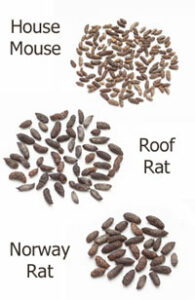
Inspect your attic and garage for rodent droppings, which look like dark grains of rice. Check along walls and near stored items. Fresh droppings are dark and moist; old ones are gray and crumbly.
Clear any standing water from your yard. Walk your property after the next time you run irrigation and note anywhere water pools or doesn’t drain within an hour.
Trim vegetation touching your home and move firewood, lumber, or debris piles at least ten feet from your exterior walls.
Don’t Wait for the Problem to Announce Itself
The pests that cause the most damage — termites, rodents, ants — are the ones that establish themselves quietly. By the time you see a swarm, a trail, or hear scratching in your walls, the underlying problem has been building for weeks or months.
April is your best shot at getting ahead of it. One professional inspection now can identify developing issues across your entire property and put a prevention plan in place before populations explode through summer.
Simple Pest Management provides proactive, prevention-first pest control across San Diego and Sacramento. Our 3-zone barrier system is built specifically for this — intercepting pests at the fence line, yard, and foundation so they never reach your living space. Every plan includes a pest-free guarantee with on-demand re-service if anything breaks through.