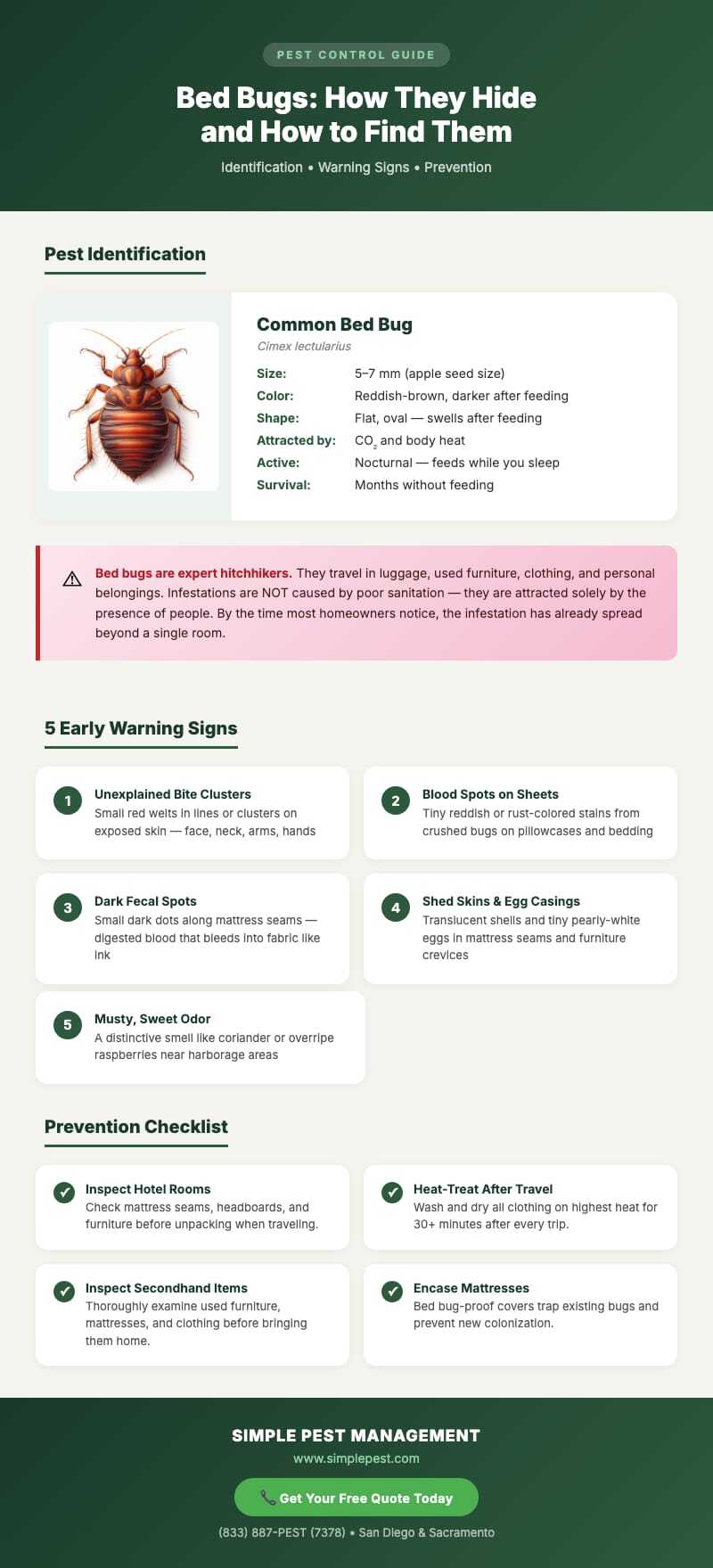

A few small blood spots on your pillowcase. A cluster of itchy welts on your arm that weren’t there yesterday. Tiny dark dots along your mattress seam that look like someone tapped a marker against the fabric. These are the earliest signs of a bed bug infestation — and most people miss them completely.
Bed bugs are nocturnal, flat enough to hide in a credit card-width crack and can establish themselves in your home for weeks before you notice anything. By the time most homeowners realize what’s happening, the infestation has already spread beyond a single room, making treatment more difficult and more expensive.
At Simple Pest Management, we’ve helped homeowners across San Diego, Sacramento, Riverside, and Placer County catch infestations early and eliminate them completely. This guide covers every warning sign to look for, how to inspect your home, and what to do (and what not to do) if you find evidence of bed bugs.
Understanding Bed Bug Behavior
Before learning to spot bed bugs, it helps to understand their behavior. Bed bugs are nocturnal parasites that feed exclusively on blood, with a strong preference for human hosts. They are attracted to the carbon dioxide we exhale and the warmth of our bodies, which is why they typically establish themselves near sleeping areas.
Adult bed bugs are about the size of an apple seed, measuring approximately five to seven millimeters in length. They have flat, oval bodies that become elongated and reddish after feeding. Juvenile bed bugs, called nymphs, are smaller and nearly translucent, making them extremely difficult to spot with the naked eye.
Bed bugs are excellent hitchhikers. They commonly travel in luggage, used furniture, clothing, and other personal belongings. This is why infestations often begin after travel, hosting visitors, purchasing secondhand items, or moving into a new residence. Unlike some pests, bed bugs are not attracted by food debris or poor sanitation. They are attracted solely by the presence of people.
The Earliest Warning Signs
Detecting bed bugs early requires knowing what to look for. The following signs may appear before you ever see an actual bed bug, making them crucial early warning indicators.
Unexplained Bites
Bed bug bites are often the first sign people notice, though they can be tricky to identify because they resemble bites from other insects. Bed bug bites typically share these characteristics:
● Small, red, itchy welts that may appear in clusters or lines
● Bites commonly appear on exposed skin during sleep, including face, neck, arms, and hands
● New bites appear regularly, often several times per week
● Bites may take several days to develop, especially if you have not been bitten before
● Some people develop no visible reaction to bites at all
It is important to note that some people never react to bed bug bites, while others develop severe reactions. If only one person in a household is showing bites, it does not mean bed bugs are not present. The insects may be feeding on everyone, but only some individuals display visible symptoms.
If you wake up with unexplained bites, especially in a pattern or line, bed bugs should be considered as a potential cause. However, bites alone are not definitive proof of bed bugs, as many other insects produce similar reactions.
Blood Stains on Bedding
One of the most telling early signs of bed bugs is small blood stains on your sheets, pillowcases, or mattress. These stains occur when engorged bed bugs are accidentally crushed during the night as you shift in your sleep. The spots are typically small, ranging from pinpoint size to the diameter of a pencil eraser, and appear as reddish or rust-colored marks.
Check your bedding carefully each time you change sheets. Pay particular attention to the areas near your pillow and along the edges of the bed where you sleep closest to the mattress seams. Blood stains may also appear on sleepwear if bed bugs are crushed while feeding.
Fecal Spots and Staining
Bed bug fecal matter is one of the most reliable early indicators of an infestation. These droppings appear as small dark spots, similar in appearance to a marker dot, and are composed of digested blood. Unlike blood stains, which smear with a reddish tinge, fecal spots are dark brown or black and will bleed slightly into fabric like ink when moistened.
Look for fecal spots in the following locations:
● Along mattress seams, piping, and edges
● On box springs, especially along the fabric covering
● Inside and around bed frame joints and crevices
● Behind headboards and on nearby walls
● On nightstand surfaces and inside drawers
● Along baseboards near the bed
The presence of fecal spotting indicates that bed bugs have been feeding in the area. Even a few spots warrant further investigation and professional inspection.
Shed Skins and Egg Casings
Bed bugs molt five times before reaching adulthood, shedding their exoskeletons at each stage. These shed skins, or cast skins, are translucent, hollow shells that retain the general shape of a bed bug. Finding cast skins is strong evidence of an active, growing infestation.
Bed bug eggs are tiny, about one millimeter in length, and pearly white in color. They are often laid in clusters and attached to surfaces with a sticky substance. Empty egg casings may be more visible than intact eggs and indicate that new bed bugs have hatched.
Shed skins and egg casings are typically found in the same hiding spots where bed bugs congregate, including mattress seams, furniture crevices, and behind wall fixtures.
Musty Odor
Bed bugs communicate using pheromones, and a significant infestation can produce a distinctive musty, sweetish odor often compared to the smell of coriander, overripe raspberries, or wet towels. This scent becomes more noticeable as the infestation grows.
By the time the odor is easily detectable, the infestation is likely well-established. However, some people with sensitive noses may notice a subtle smell in the early stages, particularly when close to the main harborage areas.
How to Inspect Your Home for Bed Bugs
If you suspect bed bugs, a thorough inspection can help confirm their presence and determine the extent of the problem. Systematic inspection is crucial for early detection.
Gathering Your Inspection Tools
Before beginning your inspection, gather the following supplies:
● A bright flashlight to illuminate dark crevices
● A magnifying glass to examine small specimens and eggs
● A credit card or thin piece of plastic to scrape along seams and crevices
● White sticky tape to capture specimens for identification
● A plastic bag to collect any evidence you find
● Disposable gloves if desired
Inspecting the Bed
Begin your inspection with the bed, as this is where most infestations are concentrated. Follow these steps:
● Remove all bedding and examine sheets, pillowcases, and blankets for blood spots and fecal stains
● Carefully inspect the mattress, starting with the seams, piping, and edges
● Flip the mattress and examine the underside, including any folds or handles
● Remove the box spring and inspect the fabric covering, especially along staples and folds
● Examine the bed frame thoroughly, including joints, screw holes, and any cracks or crevices
● If your bed has a headboard, remove it from the wall and inspect both sides
Use your credit card to scrape along seams and crevices, dislodging any bugs or debris hiding in tight spaces. Your flashlight will help you see into dark areas where bed bugs prefer to hide.
Expanding Your Search
If you find evidence of bed bugs or want to determine the full extent of an infestation, expand your inspection to nearby areas:
● Nightstands and dressers: Check inside drawers, under drawer slides, and in joints and crevices
● Upholstered furniture: Examine seams, folds, under cushions, and inside the frame
● Baseboards and wall fixtures: Look behind outlet covers, light switch plates, and along baseboard edges
● Picture frames and wall decorations: Remove items from walls and inspect the backs
● Curtains and curtain rods: Check seams and folds, especially where curtains touch the floor
● Carpet edges: Examine where carpet meets baseboards and under area rugs
● Electronics: Check alarm clocks, phone chargers, and other devices near the bed
Bed bugs can hide in surprisingly small spaces, as their flat bodies allow them to squeeze into cracks as thin as a credit card. In heavy infestations, they may spread to adjacent rooms, closets, and even into wall voids.
Action Steps If You Suspect Bed Bugs
Discovering potential signs of bed bugs can be alarming, but taking the right steps quickly can prevent the problem from worsening.
Confirm the Identification
Before taking action, try to confirm that you are dealing with bed bugs rather than another pest. Capture any insects you find using sticky tape and place them in a sealed plastic bag. You can compare your specimens to online images or bring them to a pest control professional for identification.
Keep in mind that other insects, including carpet beetles, bat bugs, and even some booklice, are sometimes mistaken for bed bugs. Accurate identification is essential for effective treatment.
Avoid These Common Mistakes
When people discover bed bugs, their first instinct is often to take immediate action. However, some common reactions can actually make the problem worse:
● Do not throw away your mattress or furniture without consulting a professional. Bed bugs can be eliminated from most items, and discarding infested items may spread bugs to other areas.
● Do not move to a different room or sleep on the couch. This can spread the infestation to new areas as bed bugs follow their food source.
● Do not use bug bombs or foggers. These products are not effective against bed bugs and may drive them deeper into hiding or into adjacent rooms.
● Do not attempt to treat the problem with excessive pesticides. Over-the-counter products rarely eliminate bed bug infestations and may pose health risks if misused.
● Do not panic. Bed bugs are a nuisance, but they can be eliminated with proper treatment.
Immediate Steps to Take
While you arrange for professional inspection and treatment, take these steps to contain the problem and prepare for treatment:
● Wash all bedding, linens, and affected clothing in hot water and dry on the highest heat setting for at least 30 minutes. Heat kills all life stages of bed bugs.
● Vacuum the mattress, box spring, bed frame, and surrounding areas thoroughly. Immediately dispose of the vacuum bag in a sealed plastic bag outside your home.
● Reduce clutter around the bed to eliminate hiding spots and make inspection and treatment easier.
● Consider encasing your mattress and box spring in bed bug-proof covers. These encasements trap any remaining bugs inside and prevent new bugs from colonizing these items.
● Inspect and isolate any items you believe may be infested, sealing them in plastic bags until they can be treated.
Seek Professional Help
Bed bug infestations are extremely difficult to eliminate without professional help. These pests are resistant to many common pesticides, can survive for months without feeding, and are expert hiders. A professional pest control company has the expertise, tools, and treatment options necessary to fully eliminate an infestation.
Professional treatment typically involves a thorough inspection to assess the extent of the problem, followed by targeted treatments that may include chemical applications, heat treatments, or a combination of methods. Follow-up inspections are important to ensure all bed bugs have been eliminated.
Preventing Future Infestations
Once you have dealt with a bed bug problem, or if you want to avoid one altogether, take these preventive measures:
● Inspect hotel rooms before unpacking when traveling. Check the mattress, headboard, and furniture near the bed.
● Keep luggage on hard surfaces away from beds and upholstered furniture in hotel rooms.
● Wash and dry all clothing on high heat after returning from travel.
● Carefully inspect secondhand furniture, mattresses, and clothing before bringing them into your home.
● Use protective encasements on mattresses and box springs to reduce hiding spots and make inspections easier.
● Reduce clutter in bedrooms to minimize potential bed bug harborage areas.
● Conduct regular inspections of sleeping areas, especially after hosting guests or returning from travel.
● Seal cracks and crevices around baseboards, outlet covers, and bed frames to reduce hiding spots.
Early Detection Is Your Best Defense
The key to managing bed bugs is catching them early, before a small problem becomes a major infestation. By learning to recognize the earliest warning signs, including unexplained bites, blood stains, fecal spots, shed skins, and musty odors, you give yourself the best chance of addressing the problem quickly and cost-effectively.
Regular inspections are especially important if you travel frequently, host guests, live in a multi-unit building, or have recently acquired secondhand furniture. A few minutes of inspection can save you weeks of dealing with a full-blown infestation.
If you suspect bed bugs in your home, do not wait. Early intervention is crucial for effective treatment. Simple Pest Management provides expert bed bug inspection and treatment services throughout California, including San Diego, Sacramento, Riverside, and Placer counties. Our experienced technicians use the latest detection methods and treatment protocols to eliminate bed bugs completely.