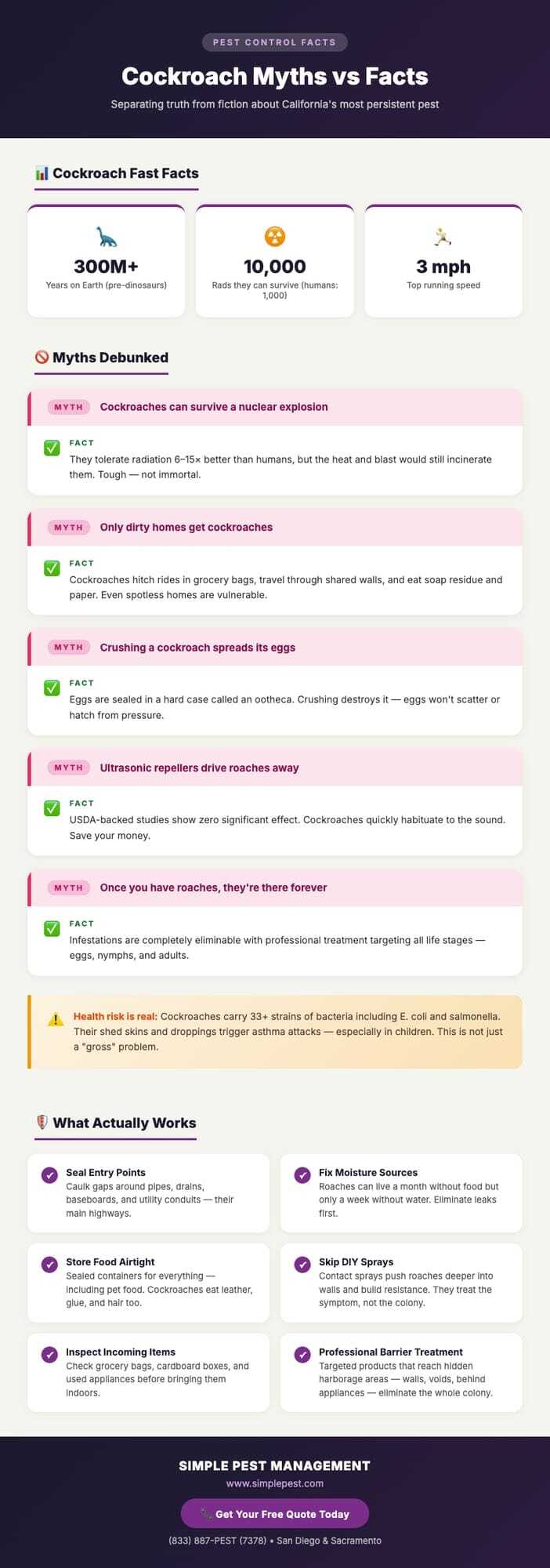

Few pests inspire as much disgust and fascination as the cockroach. These ancient insects have been scuttling across our planet for over 300 million years, predating the dinosaurs and surviving countless mass extinction events. Perhaps because of their remarkable resilience and our long shared history, cockroaches have accumulated an impressive collection of myths and urban legends. Some of these stories contain kernels of truth, while others are wildly exaggerated or completely false.
At Simple Pest Management, serving homeowners throughout San Diego, Sacramento, Riverside, and Placer counties, we encounter these cockroach myths regularly. Well-intentioned homeowners sometimes make pest control decisions based on misinformation, which can lead to wasted effort, unnecessary anxiety, or worse, ineffective treatments that allow infestations to grow. Understanding the facts about cockroach biology and behavior is essential for effective pest management.
In this comprehensive guide, we will examine the most common cockroach myths, separate fact from fiction, and provide you with accurate information that will help you better understand and control these unwelcome houseguests. Let us dive into the truth about cockroaches.
Myth 1: Cockroaches Can Survive a Nuclear Blast
The Myth: This is perhaps the most famous cockroach myth of all. The story goes that cockroaches are so hardy they could survive a nuclear explosion and would inherit the Earth after a nuclear war wipes out humanity. This belief became particularly popular during the Cold War era and has persisted in popular culture ever since.
The Facts: While cockroaches do have impressive radiation resistance compared to humans, the idea that they could survive a nuclear blast is a significant exaggeration. The immediate effects of a nuclear explosion, including the intense heat, pressure wave, and fire, would be just as lethal to cockroaches as to any other creature in the blast zone.
What is true is that cockroaches can withstand significantly higher levels of radiation than humans. Humans can tolerate about 400 to 1000 rads before lethal effects occur, while cockroaches can survive exposure to around 6,400 to 10,000 rads. This increased resistance is due to their simpler cellular structure and slower cell division rate, as radiation damage is most severe in rapidly dividing cells. However, there are other insects, such as fruit flies and certain beetles, that are even more radiation resistant than cockroaches.
The Reality: Cockroaches are tough, but they are not invincible. They can be killed by extreme temperatures, dehydration, and effective pest control treatments. In California homes from San Diego to Sacramento, properly applied treatments eliminate cockroach infestations reliably.
Myth 2: Cockroaches Only Infest Dirty Homes
The Myth: Many people believe that cockroaches are exclusively a sign of poor housekeeping. If you have cockroaches, the thinking goes, you must not be keeping your home clean. This myth leads to shame and embarrassment for homeowners dealing with infestations, and sometimes prevents people from seeking professional help.
The Facts: While poor sanitation can certainly attract cockroaches and help sustain larger populations, even the cleanest homes can become infested. Cockroaches are opportunistic survivors that need three basic things: food, water, and shelter. They can find these necessities in homes regardless of cleanliness levels.
Cockroaches often enter homes through no fault of the occupants. They can hitch rides in grocery bags, cardboard boxes, used furniture, and appliances. They can travel between units in apartment buildings and condominiums through shared walls, plumbing, and electrical conduits. In older neighborhoods common throughout Sacramento and Placer counties, cockroaches can move freely between properties through sewer systems and underground utility connections.
Furthermore, cockroaches are incredibly resourceful when it comes to finding food. While they certainly prefer easily accessible meals like crumbs and spills, they can survive on soap residue, glue, paper, leather, and even the starch in book bindings. A pristine kitchen with sealed food containers can still provide enough sustenance for cockroaches to survive.
The Reality: Cockroach infestations can happen to anyone. Good sanitation practices help reduce their food sources and can slow population growth, but cleanliness alone cannot prevent or eliminate an infestation. Professional treatment combined with sanitation is the most effective approach.
Myth 3: Crushing Cockroaches Releases Their Eggs
The Myth: A persistent urban legend claims that stepping on a cockroach or crushing it will cause its eggs to spread, leading to an even worse infestation. Some versions suggest the eggs will stick to your shoes and be carried throughout your home. This myth has led some people to avoid killing cockroaches they encounter, which only allows the pests to continue breeding undisturbed.
The Facts: This myth misunderstands how cockroach reproduction actually works. Female cockroaches produce eggs in a protective case called an ootheca. Depending on the species, the female either carries this egg case until the eggs are ready to hatch or deposits it in a hidden location shortly after formation.
German cockroaches, the most common species infesting California homes, carry their ootheca until just before the eggs hatch. American cockroaches deposit their egg cases in protected areas shortly after they form. In either case, the eggs inside an ootheca require specific conditions to develop and hatch: appropriate temperature, humidity, and time. Crushing a cockroach and its egg case would destroy the eggs, not spread them.
Furthermore, cockroach eggs are not adhesive and would not stick to shoes or surfaces to be tracked around a home. The eggs are contained within the protective ootheca case, which would be crushed along with the adult cockroach.
The Reality: Crushing a cockroach will not spread its eggs. However, simply killing individual cockroaches you see is not an effective control method, as the visible roaches represent only a small fraction of an infestation. The majority of the population remains hidden, breeding and growing in walls, appliances, and other protected spaces.
Myth 4: Cockroaches Can Live Without Their Heads
The Myth: One of the most gruesome and frequently repeated cockroach facts is that they can survive without their heads. This claim sounds like something from a horror movie, adding to the creature’s reputation as nearly indestructible.
The Facts: This one is actually true, but with important caveats. A decapitated cockroach can indeed survive for a period of time, typically one to two weeks, due to several unique aspects of their anatomy and physiology.
Unlike humans, cockroaches do not breathe through their mouths or noses. Instead, they breathe through spiracles, small openings located along their body segments that connect to a network of tubes delivering oxygen directly to their tissues. A headless cockroach can continue breathing normally.
Cockroaches also have an open circulatory system with much lower blood pressure than mammals. When decapitated, the neck simply seals off through clotting, and they do not bleed out. Their nervous system is not centralized in the brain like ours. Clusters of nerve tissue called ganglia located throughout their body can control basic functions and reflexes independently of the head.
However, the headless cockroach will eventually die because it cannot eat or drink. Without a mouth, it cannot take in water and will die of dehydration. Interestingly, the severed head can also survive for several hours, waving its antennae before eventually dying.
The Reality: While this demonstrates remarkable biology, it does not make cockroaches impossible to kill. They remain vulnerable to dehydration, temperature extremes, and properly applied pest control products. Professional treatments target roaches throughout their life cycle, ensuring complete elimination regardless of their unusual survival abilities.
Myth 5: Palmetto Bugs Are Different from Cockroaches
The Myth: In many parts of the country, people insist that the large flying insects they see are palmetto bugs, water bugs, or wood roaches, not cockroaches. The implication is that these are somehow more acceptable or natural outdoor pests, distinct from the cockroaches associated with dirty conditions.
The Facts: Palmetto bug, water bug, and wood roach are all common nicknames for various species of cockroaches. In California and across the Southern United States, the term palmetto bug most often refers to the American cockroach, our largest common species at up to two inches in length. These names do not indicate different insects; they are simply regional or colloquial terms for cockroaches.
American cockroaches, the so-called palmetto bugs, are indeed more commonly found outdoors and in damp areas like sewer systems. They often enter homes through drains or gaps around utility pipes. However, they are still cockroaches, with the same basic biology and potential to infest homes and contaminate food. Throughout San Diego, Riverside, and other California counties, these large cockroaches are frequently found in and around homes, particularly near water sources.
The Reality: A cockroach by any other name is still a cockroach. Whether called a palmetto bug, water bug, or sewer roach, these insects can carry pathogens, trigger allergies and asthma, and contaminate food. They require the same professional treatment approaches as any other cockroach species.
Myth 6: Ultrasonic Repellers Effectively Eliminate Cockroaches
The Myth: Electronic ultrasonic pest repellers claim to drive away cockroaches and other pests by emitting high-frequency sound waves that are intolerable to insects but inaudible to humans. These devices are marketed as a clean, chemical-free, effortless solution to pest problems.
The Facts: Despite widespread marketing and millions of units sold, scientific research has consistently shown that ultrasonic pest repellers are ineffective against cockroaches. Multiple independent studies, including research funded by the United States Department of Agriculture, have found that these devices have no significant impact on cockroach behavior or populations.
While cockroaches can detect some ultrasonic frequencies, they do not find these sounds repellent enough to leave an area with adequate food, water, and shelter. In laboratory tests, cockroaches showed initial mild responses to ultrasonic sound but quickly habituated and ignored it. Real-world conditions, where furniture, walls, and other objects block and absorb sound waves, make these devices even less effective.
The Reality: Save your money on ultrasonic repellers. Effective cockroach control requires a combination of sanitation, exclusion, and targeted treatments applied by knowledgeable professionals. There are no shortcuts or magic solutions when it comes to eliminating these persistent pests.
Myth 7: Once You Have Cockroaches, You Can Never Get Rid of Them
The Myth: Given all the stories about cockroach resilience, many homeowners believe that once these pests establish themselves, elimination is impossible. This fatalistic view leads some people to simply accept living with cockroaches or to give up after failed DIY treatment attempts.
The Facts: Cockroach infestations absolutely can be eliminated with proper treatment. The key factors for success include correct identification of the cockroach species, thorough inspection to locate all harborage areas, appropriate treatment methods targeting the specific infestation, addressing conducive conditions like moisture problems and entry points, and follow-up monitoring and treatments as needed.
Many DIY treatments fail because they only address visible cockroaches while leaving the hidden population untouched. Over-the-counter sprays may kill roaches on contact but often repel others deeper into walls and voids where they continue breeding. Professional pest control uses targeted products and techniques that eliminate entire populations, including eggs, nymphs, and adults.
The Reality: With professional treatment and proper follow-up, cockroach infestations can be completely eliminated. Throughout California, from San Diego’s coastal communities to Sacramento’s capital district to the neighborhoods of Riverside and Placer counties, we have helped countless homeowners reclaim their homes from cockroach infestations. It requires expertise and persistence, but it is absolutely achievable.
Understanding Cockroach Facts for Better Control
Now that we have debunked common myths, here are some actual cockroach facts that are relevant to pest control in California homes. Cockroaches are primarily nocturnal, so seeing them during daylight hours often indicates a severe infestation where overcrowding is pushing individuals out of hiding. They prefer warm, humid environments, which is why bathrooms, kitchens, and areas around water heaters are common hotspots.
Cockroaches are indeed fast runners, capable of moving about three miles per hour, which allows them to spread bacteria and pathogens quickly throughout a home. They can trigger allergies and asthma, particularly in children, through proteins found in their droppings, shed skins, and decomposing bodies. They can squeeze through incredibly small spaces, with German cockroaches able to fit through gaps as thin as a dime.
Understanding these real facts about cockroach behavior helps inform effective control strategies. Knowing when and where cockroaches are active, what attracts them, and how they move through buildings allows pest control professionals to target treatments effectively.